
Verifying a Valentino Garavani Bag Step by Step
Authentication is an ordered routine, not a single once-over, and the order of the steps counts more than the average guide concedes. Run it in the wrong order and you may spend twenty minutes studying stitching on a bag the company you think you are buying from never made. What follows is that sequence, aimed at someone with the bag in hand or a detailed listing on screen, with each check doing one job and then handing off. Two warnings before you begin. This house does not operate the kind of date-code system some buyers expect, and a number of details passed around as decisive proof are nothing of the kind, so each step spells out the limits of what it proves. Nothing here replaces a professional authentication service on a high-value purchase; it just helps you see when one is worth the fee.
Step 1. Work out who actually made the bag
A mistake here makes every later check meaningless, which is why it leads. Two unrelated companies sell handbags under the Valentino name: the Rome couture house founded in 1960, whose leather goods are marked VALENTINO GARAVANI, and Mario Valentino S.p.A., a leather goods and footwear house founded in Naples in 1952, selling as Valentino by Mario Valentino. Under a 1979 coexistence agreement, the couture house is contractually required to use GARAVANI alongside VALENTINO on leather goods and their advertising, which is the whole reason that second word appears. A genuine Mario Valentino bag will fail every remaining check on this list while being completely authentic, and the mis-selling runs both ways. So read the branding first and decide which company you are dealing with before the question of real or fake even comes up. An exterior reading only Valentino with an interior reading Mario Valentino? You have an authentic piece from the Naples company, not a fake valentino garavani bag.
Step 2. Take the interior tag apart word by word
The interior tag is where a single check earns the most, and it rewards patience. A genuine piece should show VALENTINO and GARAVANI in capitals alongside MADE IN ITALY, because the brand’s own product pages confirm Italian manufacture. Check the attachment before the wording: stitched down on all four sides, lying flat, no loose corner, no glue. Next, read the valentino handbags lettering, confirming that font weight is consistent across every character and that the impression is even rather than blurred, doubled or shallow here and there. Since fakes usually copy the text well and the pressure poorly, the stamp’s physical quality is as important as the wording. If the tag is missing, or names only one of the two words, treat it as a serious concern.
Step 3. Use serial numbers as evidence, and forget date codes
Serial numbers do exist, typically on a tag set inside an interior pocket, commonly in black, cream or light brown. Take a photograph of it and check that it is stamped as cleanly as the main interior tag. Here is the part that trips buyers up: the serial is not used across the whole house, and some older models may never have carried one. A missing serial does not prove a bag is fake, and anyone who says otherwise is oversimplifying; and its presence proves little either, given how easily numbers are copied. Remember also that this house runs no date-code system of the kind used elsewhere: there is no stamped string decoding to a factory and a week of production. If a listing quotes you a date code, the seller is talking about a different brand or making up reassurance, and both of those are reasons to slow down. The same goes for the related folklore: the notion that lining colour proves authenticity is unverified and should not decide the question.
Step 4. Size up the authenticity card correctly
By report, these bags come with a card, showing model specification, a serial number and a Made in Italy line matching the interior tag. The description originates in resale and authentication guides, and not from any official statement by the house, so read it as market practice. When a card comes with the bag, look for agreement: card number and bag number should be the same, and a mismatch is a genuine red flag. The absence of a card supports no conclusion, since pre-owned bags regularly show up without one after years of ownership and resale. You will see sellers price a card as a certificate of authenticity, though it is nothing of the sort, and cards are copied as easily as tags. The card is worth only what it corroborates, not the bare fact that it exists.
Step 5. Inspect the hardware and its engraving
Given that engraving is expensive and printing cheap, it is the hardware that exposes counterfeit economics. On genuine pieces logo marks are engraved instead of printed, with a depth your fingernail can catch and edges that remain sharp when magnified. Zip pulls observed on the line come square with rounded corners, carry the same deep engraving, and ought to have real weight rather than feeling hollow. Expect a restrained metal tone rather than a brassy one; observed finishes include antique-brass, light gold and platinum, which makes garish yellow gold worth a second look. Tone and finish should be identical across every piece of hardware, because mismatched pieces betray parts bought from different places. These finishes are plated, and that shapes how the bag should be cared for.
Step 6. Studs first, stitching second
The studs are a legitimate test in their own right, since the house signature is a stud. Compare the pyramids for height, facet angle and flat top, and none of them should wobble, spin or stand proud of the leather. The second half of the test is spacing: even spacing on a strap or flap edge resists volume faking and reads clearly by eye. Move on to the stitching next, which should be even in length, straight along the seams and consistent in density from panel to panel. Little gives a counterfeit away more reliably than a wandering stitch line, a loose thread or tension that changes along one seam, as they are precisely the details that cannot be industrialised cheaply. Spend time on an edge that runs the full length of the bag, which is where inconsistency shows.
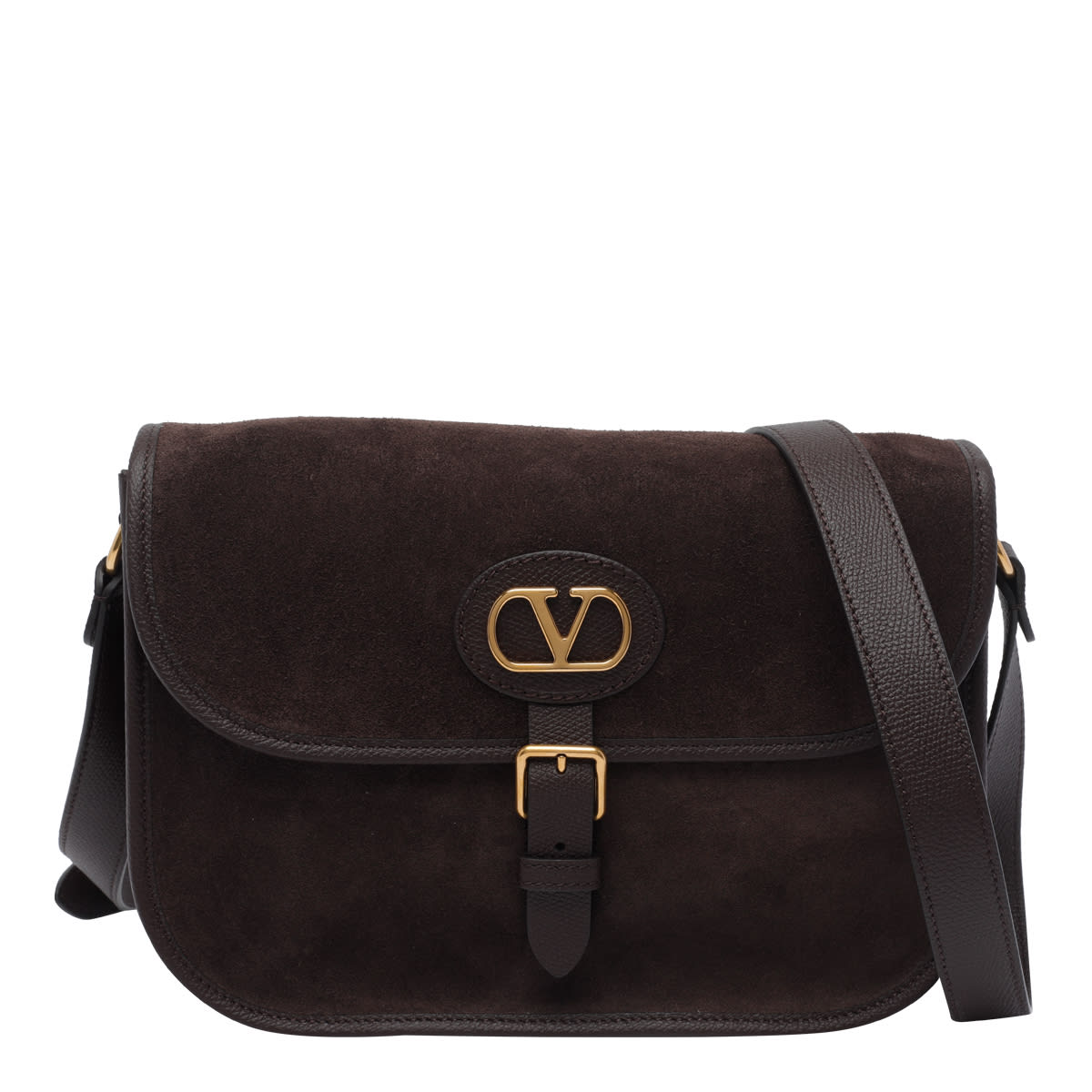
Step 7. Run the price check and weigh the seller
Price does real work as a check, catching listings that survive every physical test in photographs. Hold the asking price up against observed 2026 market prices on the brand’s own United States site: Rockstud runs $1,250 to $2,100, Rockstud Spike $2,400 to $3,700, Locò $2,700 to $5,900, VSling $3,350 to $6,550 and VLogo Signature $650 to $3,750. On the resale side the numbers matter too: one major platform’s observed retention puts the house near 41 per cent of retail, with motif styles around 50 to 58 per cent, which means a used valentino shoulder bag at a tenth of retail is telling you something loudly. Apply the same rigour to the seller as to the bag: the brand’s own boutiques and webstore, or named authorised retailers such as Neiman Marcus, Bergdorf Goodman, Saks Fifth Avenue, Mytheresa, Net-a-Porter and Farfetch. On the resale side, well-established platforms including Fashionphile, The RealReal, Rebag, Vestiaire Collective, Collector Square and 1stDibs authenticate in-house before anything is listed. A bag that passes while the seller and the price both look wrong is still a bag to leave: find the same model somewhere accountable.
The whole checklist at a glance
Use the table as a summary, not a substitute for the steps above, because it is the third column where most mistakes happen. A number of these checks are strong on failure and weak on a pass, which is the asymmetry worth internalising. No interior tag is damning; its presence is no more than encouraging. A serial that does not match is damning; a missing serial says very little. Do not shuffle the order, since working out the maker first spares you a checklist that does not apply. Two or more negative rows is the point to stop and pay for a professional opinion.
| What you check | What the real thing looks like | What a negative really proves |
|---|---|---|
| Which maker | VALENTINO GARAVANI marked on the leather goods | Where the outside says only Valentino and the inside says Mario Valentino, the maker is a different, authentic company |
| Interior tag | VALENTINO and GARAVANI in capitals alongside MADE IN ITALY, four sides sewn | No tag, or only one of the two words, counts as a serious concern |
| Serial numbering | Typically on a tag within an interior pocket, with clean stamping | Absence by itself proves nothing, since older models may never have had one |
| The date code | There is no date code, since the house operates no date-code system | A quoted date code means the seller is describing another brand |
| Authenticity card | Reports describe model, serial and a Made in Italy line matching the tag | Absence is normal, since pre-owned bags often arrive without one |
| The metal parts | Engraved, not printed, deep and even, with a restrained tone | Printed, faint or smudged marking counts as a strong negative |
| The studs and the stitching | Pyramids alike, spacing even, stitching aligned and consistent in density | Wobble, uneven gaps or wandering seams count as strong negatives |
